In modern high-end precision manufacturing, whether processing automotive optics lenses, brightening the perimeters of large-format LCD glass panels, or performing edge polishing on semiconductor wafers (such as Si, SiC, and GaN), surface quality is the absolute determinant of end-product performance and structural integrity. While conventional rigid diamond or silicon carbide (SiC) grinding wheels possess aggressive bulk cutting forces, relying solely on physical abrading when processing brittle-hard glass or crystal substrates inevitably leaves superficial micro-scratches and destructive subsurface damage (SSD).
To break through traditional mechanical boundaries during final-stage finishing and achieve a flawless, atom-level specular finish, Honway has introduced high-precision Cerium Oxide Elastic Grinding Wheels along with specialized polishing pads. This technical brief explores this advanced glass mirror polishing technology—a system that integrates chemical activity with an elastic physical matrix—and breaks down how it has become an indispensable specification on premium automated production lines.
📌 Table of Contents
- 1. Chemical Attrition: Why Rigid Abrasives Cannot Replicate $CeO_2$ Chemical Removal Mechanics
- 2. The Shock-Absorbing Matrix: How Elastic Bonding Agents Neutralize Tool Micro-Vibrations
- 3. Production Line Diagnostics: Resolving Glass Edge Chipping and Surface Haziness
- 4. Advanced Applications: Wafer Edge Polishing and Precision Aspherical Optics
- 5. Metrology & Automation: Surface Roughness Calibration and Process Scaling
- 6. Comprehensive B2B Technical Sourcing & Customization Interface
1. Chemical Attrition: Why Rigid Abrasives Cannot Replicate $CeO_2$ Chemical Removal Mechanics
Understanding the irreplaceability of a Cerium Oxide elastic grinding wheel requires analyzing its material removal mechanics at a microscopic scale. The operation of traditional abrasives relies on rigid, forced mechanical micro-cutting, which causes high stress concentrations along hard-brittle glass lattices and leads to localized micro-fracturing. Conversely, when Cerium Oxide ($CeO_2$) acts on silicate glass (primarily silicon dioxide, $SiO_2$), it triggers a unique dual-action Chemical Mechanical Polishing (CMP) phenomenon:
- Physical Micro-Abrasive Shearing: The $CeO_2$ micro-grains embedded within the elastic wheel matrix act as tiny, highly distributed cutting edges. They execute minute physical abrading that flattens microscopic asperities across the glass surface.
- Solid-State Chemical Interaction: Accelerated by localized polishing pressures and frictional heat, a strong chemical affinity is triggered between the Cerium Oxide and the Silicon Dioxide on the glass surface. This reaction forms transient, localized $\text{Ce–O–Si}$ chemical bonds. Driven by the high shear forces of wheel rotation, the $CeO_2$ particles pull and strip surface-level molecules directly away from the glass substrate.
This chemical removal pathway means material displacement no longer depends on physical tearing, enabling an atom-level smooth transition. This mechanism explains why Cerium Oxide maintains an absolute monopoly in optical polishing and edge brightening where haze-free and scratch-free surface characteristics are mandatory. To accommodate diverse production fixture and tooling designs, Honway concurrently provides fully customizable Cerium Oxide Polishing Leather (available in bespoke sheet or shank-mounted configurations) to support varied mirror-brightening equipment setups.
2. The Shock-Absorbing Matrix: How Elastic Bonding Agents Neutralize Tool Micro-Vibrations
Beyond the chemical benefits of Cerium Oxide, the secondary core innovation of this wheel type lies in its engineered elastic binder structure. Conventional metallic or resinoid bond matrices are rigid. When automated production spindles undergo high-frequency micro-vibrations, or when incoming workpieces exhibit minor geometric variations, the grinding wheel transfers this kinetic energy forcefully against the face, causing severe tool chatter which can fracture or strip sub-surface matrices.
Honway’s advanced elastic matrices and high-tensile backing sheets provide essential structural damping during automated mass production via several mechanisms:
- Damping High-Frequency Vibrations: The elastomer acts as a continuous shock absorber along the spindle interface. It dynamically dampens micro-vibrations generated by external mechanical motion, ensuring grinding forces remain uniformly distributed.
- Conformal Contact Area Expansion: When executing edge grinding on glass sheets or semiconductor wafers, the elastic wheel deforms slightly under load to match the specific R-profile or C-chamfer geometry of the perimeter. This elastic compliance achieves absolute profile conformity, ensuring uniform surface roughness ($R_a$) across the entire bevel area.
- Controlled Self-Sharpening Cycles: The elastic matrix erodes at a controlled rate during operation. Spent, dulled $CeO_2$ grains shed naturally from the matrix, continuously exposing fresh, sharp, chemically active micro-grains beneath. This steady rejuvenation eliminates chip-loading and wheel loading, preventing workpieces from suffering friction-induced burning or severe scratching defects.
3. Production Line Diagnostics: Resolving Glass Edge Chipping and Surface Haziness
On high-volume automated lines producing LCD panel glass or automotive cover sheets, process engineers consistently combat two major yield challenges: micro-edge chipping and post-polishing surface haziness. Perimeter chipping concentrates local stresses, causing glass components to fracture during downstream thermal tempering or final product assembly. Surface haziness severely undermines the optical transmission and sensor accuracy of cover glass assemblies.
Honway’s Engineered Countermeasures: These defects are typically caused by overly coarse grit sizing in preceding processing stages or inadequate isolation of spindle vibrations from rigid tools. When assisting production facilities with line calibration, Honway’s applications engineers introduce controlled elastic abrading processes. The porous micro-architecture of Honway’s Cerium Oxide Elastic Grinding Wheels dissipates frictional heat while its chemical activity completely planarizes the sub-surface micro-fracture layers left by preceding diamond stages. This process drops perimeter chipping rates below 0.5% and eliminates scattered light reflections. For specialized tooling fixtures, integrating Honway’s Cerium Oxide Polishing Leather transforms hazy, diffuse profiles into clean, mirror-grade specular finishes.
4. Advanced Applications: Wafer Edge Polishing and Precision Aspherical Optics
Driven by industry upgrades, this process has expanded beyond traditional glass processing into premium sectors like semiconductor foundries and advanced optical mold fabrication. Honway provides custom formulations and tailored structural specifications to meet the rigorous tolerances of these high-value industries:
| Target Sector | Process Challenges & Geometry Constraints | Honway Cerium Oxide Technical Synergies |
|---|---|---|
| LCD Panels & Cover Glass Display Assemblies | Requires rapid brightening of large glass perimeters during high-speed feed cycles. Must eliminate all edge whitening and micro-indents to prevent bend-induced breakage. | High-toughness elastic matrices deliver exceptional wear life for automated, continuous high-speed perimeter grinding. Integrates smoothly with customized Cerium Oxide Polishing Leather (Sheets/Shanks) for localized debugging. |
| Optical Lenses & Precision Molds | Aspherical glass elements used in automotive wide-angle cameras and premium imaging modules. Demands completely scratch-free polishing with strict limitations on surface roughness. | Electronic-grade, 99% high-purity chemically active Cerium Oxide formulations are blended with ultra-fine particle tracking to achieve high clarity and haze-free finishes. |
| Semiconductor Wafer Edge Polishing | Notch profiles and peripheral rounds on Silicon, Silicon Carbide (SiC), and Gallium Nitride (GaN) wafers. Must eliminate edge anomalies that cause sub-surface stress and subsequent epitaxial defects. | Highly porous microstructures precisely manage peripheral tolerances and process heat dissipation. This refined control allows edge topography profiles to predictably achieve a surface finish of $Ra < 0.02 \mu m$. |
5. Metrology & Automation: Surface Roughness Calibration and Process Scaling
When tuning process variables for Cerium Oxide wheels—such as linear velocity, flow rates of cooling water, and downward working pressures—production supervisors and process engineers require clear metrology metrics to verify factory yield tolerances. To map raw physical surface data into standardized engineering metrics or integrate high-end abrasive wheels with automated, clog-free processing machinery, we recommend reviewing Honway’s technical insight guides:
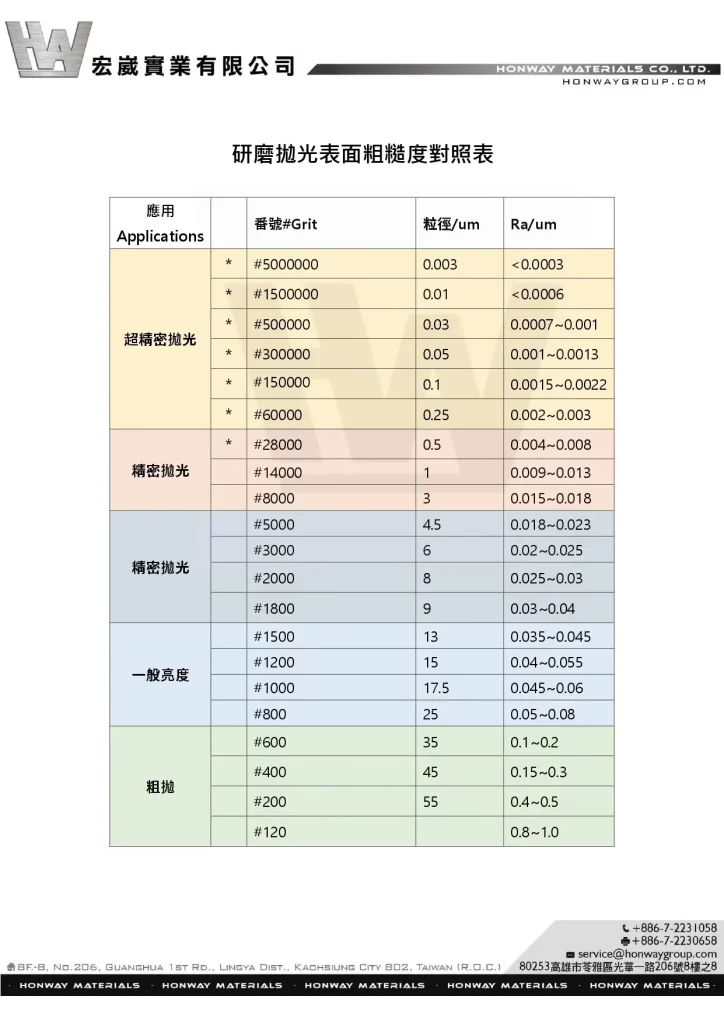
- 📊 Metrology Conversion Standards: Grinding, Polishing, and Surface Roughness Comparison Chart: Mastering Micro- and Nano-Scale Conversions Across Ra, Rz, Old S, and ▽ Classes
- 🎯 Advanced Machinery Sourcing: Industrial Polishing Platforms and Meta Polishing Systems: Complete Elimination of Piping Clogs and Edge Roll-Off Over-Polishing
6. Comprehensive B2B Technical Sourcing & Customization Interface
Honway Group is a long-term partner in high-end industrial raw materials, advanced semiconductor consumables, and precision surface processing equipment. We recognize that within premium optics, display configurations, and wafer fabs, no single generic consumable can cover every processing variables. For this reason, Honway supports its materials with an integrated system approach, including a dedicated application demonstration center, comprehensive machine prototyping test bays, and field application engineering teams ready for onsite deployment.
Whether your line is troubleshooting a sudden glass edge haziness crisis, seeking higher-purity optical polishing consumables, or requiring customized elastic formulations for unique composite substrates, Honway delivers precise prototyping and technical alignment to help fulfill your brand’s commitment to peak operational efficiency.
Verified Honway Product Portfolios for Global Inquiries & Sample Orders
Browse our verified online catalog below to order sample quantities directly with premium worldwide shipping logistics, or connect with our customer success desk for contract bulk pricing arrangements.
- Bespoke Cerium Oxide Solutions: Cerium Oxide Polishing Leather (Bespoke Sheets & Shank-Mounted Configurations) Sourcing Portal
- Automated Machinery System: Industrial Polishing & Deburring Platforms Product Section
- Polishing Film Master Directory: High-Precision Polishing Film Classification Index
- Diamond PE Film Landing Page: HW-661X Diamond Film / Diamond PE Film Dedicated Product Page
- Magnetic Core Base Platens: Honway Magnetic Disc Specifications Page
- Teflon Protective Barriers: Honway Teflon Anti-Stick Disk Integration Interface
- Coarse Stage Carrier (Electroformed): Honway Rigid Electroplated Diamond Platens
Honway Customer Success Office (Taiwan Headquarters HQ)
· 📨 Corporate RFQ Inquiries: Click to immediately route to 【Contact the Honway Technical Projects Team】. State your specific substrate material parameters (Glass, Quartz, SiC, or GaN) and current process bottlenecks. Our desk will assign a dedicated semiconductor applications engineer within 24 business hours.
· 📞 International Hotline: +886 7 223 1058 (Monday – Friday, 09:00 – 18:00, GMT+8)
· 📱 Official Communications Channel: Access the Honway Group Corporate LinkedIn Feed for direct corporate product engineering messaging.