In the world of precision machining, a diamond is not just a diamond—it is the defining factor that determines whether your product achieves a flawless, mirror-like finish. If you are currently struggling to select the right diamond powder, or wondering why certain premium diamond abrasives command a higher price tag, this comprehensive guide is tailored to answer all your questions at a glance.
Revolutionary Tech in Polishing: The Ultimate Selection Guide for Polycrystalline V.S. Monocrystalline Diamonds
“On the production line, technicians frequently encounter frustrating bottlenecks: despite utilizing the correct grit size, the workpiece surface still ends up with deep scratches; or, when processing materials like aluminum, cemented carbide, or ceramics, the surface remains hazy and fails to achieve a mirror finish. More often than not, this is not a matter of technical skill—it is because you have selected the wrong diamond crystal structure!”
Structure: It consists of countless sub-micron crystallites fused together.
The Signature Feature—Self-Sharpening: This is the most defining advantage of polycrystalline diamonds. Instead of shattering entirely under friction, it undergoes controlled micro-fracturing—shedding layer by layer, much like peeling an onion—to continuously expose fresh, sharp cutting edges.
Advantages: Delivers a fast and stable material removal rate (MRR), ensuring superior surface uniformity with absolutely zero deep scratches.
Revolutionary Tech in Polishing: The Ultimate Selection Guide for Polycrystalline V.S. Monocrystalline Diamonds
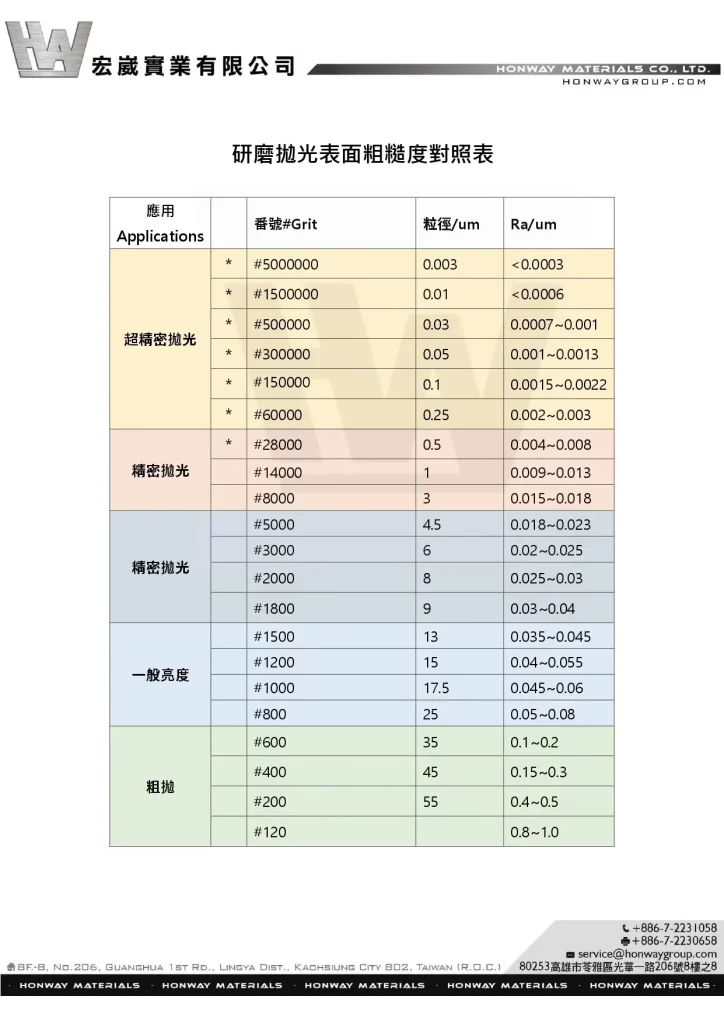
Tailored to distinct processing stages and material characteristics, HonWay Materials Co., Ltd. provides specialized product classifications. Skip the complex specifications—this comprehensive chart tells you everything you need to know:
Step 1: Identify your current processing stage.
Processing Stage
Recommended Grit Size (#Grit)
Purpose
Rough Polishing
#200 ~ #600
Rapid leveling and high-rate material removal
Pre-polishing
#800 ~ #1500
Eliminates rough grinding marks, laying a flawless “foundation” for the final finish.
Precision Polishing
#1800 ~ #5000
Enhances surface refinement for high-precision components, such as molds, dies, and tool steels.
Final Mirror Finish
#8000 ~ #300000
Achieves nanometer-scale luster, delivering a surface so pristine it provides true specular reflectivity.
In the world of precision machining, “grit designation” and “particle size” are analogous to the mesh number and grain size found in sandpaper classification.
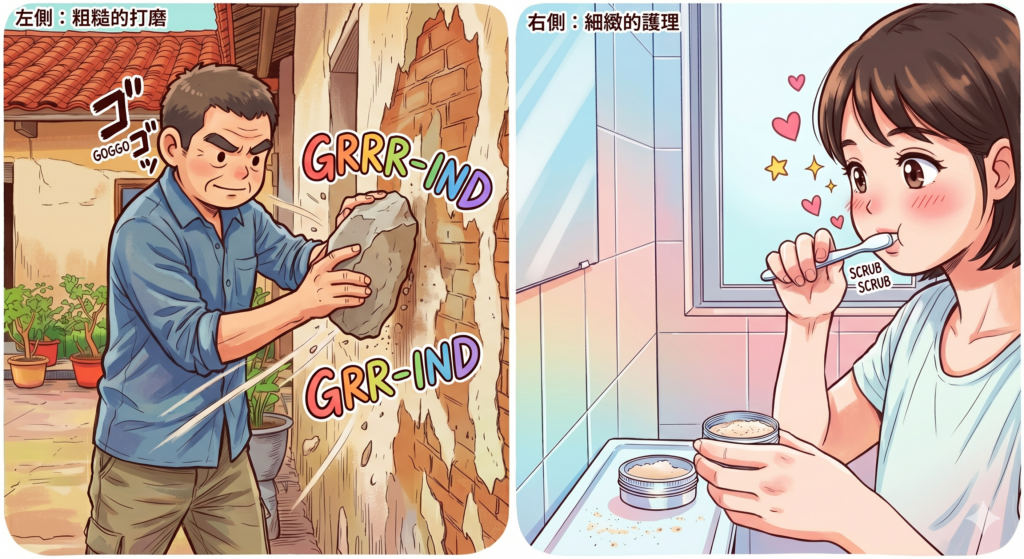
Simply put, this determines whether your polishing process resembles “grinding down a wall with coarse boulders” or “polishing teeth with ultra-fine powder.”
Below is an intuitive comparison chart and comprehensive breakdown designed to make these two concepts easy to understand:
Grit Designation (#Grit)
Particle Size (μm)
Visual Analogy
Primary Applications
#200 ~ #600
Coarse Particles
Resembles coarse grit, with a distinct tactile graininess to the touch.
Coarse Grinding & Polishing: Rapid planarization of uneven surface topography.
#800 ~ #1500
Medium Particles
Resembles fine sand, providing a high-friction, textured feel to the touch.
Standard Pre-Polishing: Erases coarse grinding patterns, transforming the surface into a uniform, semi-matte sheen.
#1800 ~ #5000
Fine Particles
Resembles fine table salt, with particles that are virtually indistinguishable to the naked eye.
Precision Polishing: Enhances surface refinement, bringing out a brilliant metallic luster.
#8000 ~ #300000
Ultra-Fine Powder
Resembles cosmetic foundation, with an exceptionally silky, frictionless smoothness to the touch.
Mirror Polishing: The ultimate step to achieve a flawless, mirror-like reflectivity.
If your goal is to transform a rough iron block into a flawless mirror finish, the sequential progression must be as follows:
Begin with a low grit designation (e.g., #400): Achieves expedited leveling of the initial surface roughness.
Follow with a medium grit designation (e.g., #1200): Blends out the deeper scratches left by the coarse abrasives.
Conclude with high grit designations (e.g., #10000 and above): Conducts the final “ultra-precision finishing” to achieve a nano-scale surface profile.
Pro Tip: Avoid skipping grit sequences too drastically (e.g., jumping directly from #400 to #10000). Otherwise, the deep subsurface grooves left by the coarse particles cannot be eliminated by the fine micron powders.
Step 2: Select the Appropriate “Polycrystalline” Grade (Helps you precise control your costs)
Grade Designation
Recommended Applications
Product Features
Recommended Products
BP (Flagship Series)
High-Value Optical Components
Top-Tier Performance: Delivers a flawless, ultra-reflective mirror finish—making it the premier choice for those pursuing ultimate quality.
If you are processing glass or optical lenses, opt for the BP Series directly.
For ceramic applications, YP is the ideal match.
For general steel applications, RP yields the highest efficiency.
Step 2: Evaluate Your Budgetary Considerations
If you are budget-constrained but refuse to compromise on finish quality, GP is the ultimate lifesaver. While highly economical, it still retains the stable performance intrinsic to polycrystalline diamonds.
Step 3: Understand the Core Selection Logic
These four distinct grades are meticulously designed to help you optimize and control your processing costs. There is no need to deploy the most expensive materials for every single application; by matching the correct grade to your specific substrate, you can maximize cost-savings while achieving a flawless surface finish.
1. Comprehensive Grit Spectrum: From coarse grinding (#200 / Black) to ultra-mirror polishing (#14,000 / White), we offer a complete range of corresponding specifications.
2. Polycrystalline Self-Sharpening Property: Polycrystalline diamonds feature a micro-fracturing mechanism that delivers a self-sharpening effect, yielding a significantly finer surface finish than monocrystalline diamonds.
3. High Material Removal Rate (MRR): Due to its inherent crystal structure, monocrystalline diamond excels in high-efficiency, large-area stock removal.
1. General Precision Machining: Optimized for the precision polishing and finishing of hard metals, technical ceramics, optical glass, and LCD glass substrates.
2. Routine Restoration & Maintenance: Ideal for the refurbishment of fine jewelry and routine polishing treatments for standard molds and dies.
3. Cost-Effective Alternative: Serves as a highly economical abrasive consumable, perfectly suited for most industrial components from coarse lapping to fine polishing.
or the lightweight, low-vibration “U-Lap Pneumatic Grinder & Profiler Series“. This seamless integration of premium abrasives and high-performance power equipment allows you to rigorously safeguard micron-level geometric tolerances.