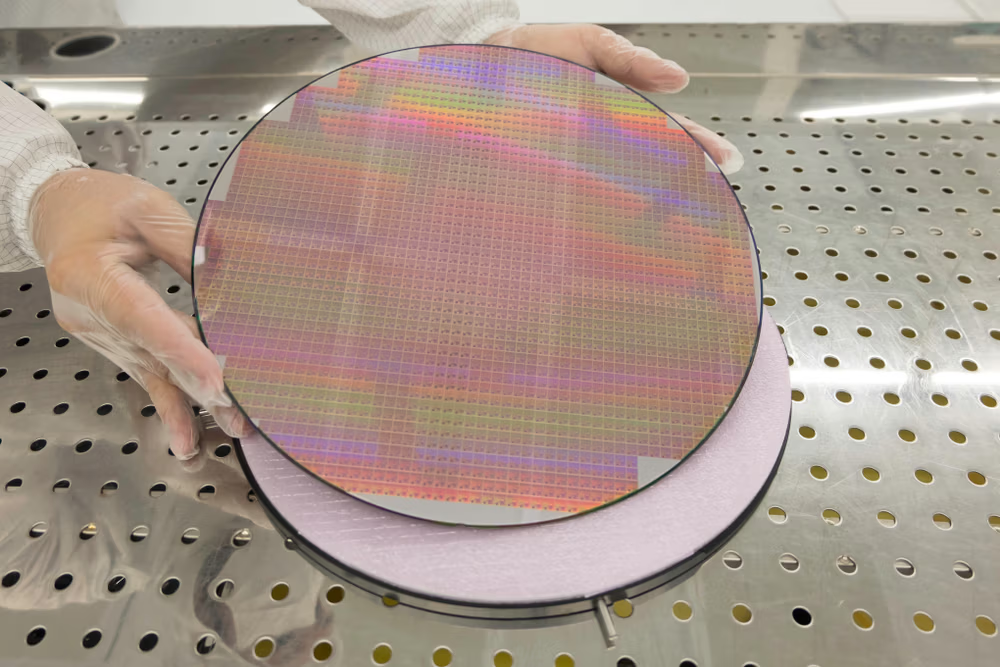
In semiconductor failure analysis (FA) and metallurgical quality control (QC) laboratories, processing throughput directly dictates organizational operational efficiency. However, many testing facilities still rely on conventional mechanical clamping rings or plastic fastening bands to secure waterproof silicon carbide (SiC) papers and grinding substrates.
Forcing technicians to manually prize open rigid metallic rings, align consumable components, and apply force for every grit progression introduces physical strain and constrains sample preparation throughput. To eliminate this workflow bottleneck, the Honway technical team presents this engineering guide to modern metallographic magnetic fixation systems, detailing how a structural “1+N” quick-change architecture optimizes laboratory sample preparation.
Table of Contents
- 1. The Mechanical Constraints of Conventional Clamping Ring Fixation
- 2. Engineering Architecture of the 1+N Magnetic Fixation System
- 3. Advanced System Alignment & Technical Product Matching Matrix
- 4. Metallographic Magnetic Fixation Operational FAQ
- 5. Engineering Knowledge Base: Advanced Surface Finishing Reference
- 6. Workflow Optimization: Transitioning to High-Throughput Diagnostics
1. The Mechanical Constraints of Conventional Clamping Ring Fixation
When assessing laboratory automation and upgrading sample preparation lines, the rotational velocity and down-force parameters of the grinding platen are critical. However, the auxiliary time required for consumable changeovers represents the true processing differentiator. Conventional perimeter clamping rings exhibit three structural limitations:
- Technician Fatigue and Operational Delay: Mechanical steel rings require significant manual force or specialized hand tools to expand and secure. For laboratory technicians processing dozens of failure analysis samples daily, continuous grit step transitions introduce physical fatigue and extended process tracking cycles.
- Geometric Distortion and High-Speed Component Ejection Risks: Metallic clamping rings subjected to repeated tensile cycling inevitably experience microscopic structural deformation. If the ring fails to maintain a 100% uniform radial grip on the master platen, the grinding plate can dislodge or delaminate at high rotational velocities (hundreds of RPM), destroying delicate specimens and damaging equipment.
- Perimeter Protrusions Constraining Sample Trajectory: Raising a mechanical clamping ring creates an elevated profile around the platen perimeter. This boundary restricts the horizontal travel of automated multi-specimen specimen holders, risking accidental holder-to-clamp collisions and preventing full-surface utilization of the grinding media.
2. Engineering Architecture of the 1+N Magnetic Fixation System
Modern metallographic magnetic fixation systems utilize a magnetic interface circuit. The structural layout consists of a singular high-flux magnetic master base plate (“1”) paired with multiple iron-backed or magnetically receptive abrasive carriers (“N”):
A. Three-Second Disc Change and Automatic Centering Alignment
- The “1” Permanent Magnetic Base Platen: This component mounts directly onto the aluminum driving platen of the grinding machine. Honway utilizes specialized permanent magnetic materials possessing high magnetic flux density and chemical corrosion resistance, ensuring long-term magnetic retention even when exposed to chemically aggressive polishing chemistries.
- The “N” Integrated Abrasive Material Carriers: Whether utilizing electroplated diamond plates or patterned honeycomb fine-grinding configurations, the substrate backings feature an integrated, high-flatness magnetically conductive steel sheet.
The technician places the designated abrasive plate onto the magnetic base plate; the high-intensity magnetic flux instantly centers and secures the component. Transitioning to the next grit step requires only a single manual lift from the perimeter edge, achieving a fluid changeover cycle.
B. Capex Mitigation Through Magnetic Surface Adaptation
Historically, to establish a multi-stage sequential grinding line without manual abrasive replacement delays, facilities were forced to procure multi-platen metallographic polishing systems (dual or triple platen units), incurring substantial capital expenditure. The high-intensity magnetic fixation system alters this economic constraint.
By implementing the “1+N” architecture, a single-platen grinding system transitions into an adaptable processing station. Laboratories no longer need multi-machine arrays for sequential processing; integrating a single magnetic platen enables rapid grit variations on a single unit, delivering multi-platen throughput with minimal hardware investment.
C. Micro-Resin Teflon Anti-Sticking Matrix Technology
Standard low-tier magnetic platens often suffer from moisture ingress between the magnetic interface and the steel backing plate, leading to severe localized oxidation, iron-oxide buildup, and component seizure. To prevent this, Honway introduces its proprietary Teflon Anti-Sticking Coating technology.
A micron-scale, high-density Teflon composite layer is applied uniformly across the active surface via the Honway Teflon Anti-Stick Disk infrastructure. This layer provides low surface energy along with hydrophobic and oleophobic properties. It seals the assembly against water and ambient air ingress to eliminate substrate oxidation while preventing chemical precipitation from colloidal silica or alumina suspensions from bonding the elements. Even during continuous wet processing cycles, the grinding plate remains easily removable, eliminating maintenance seizures.
D. Preventative Maintenance Protocols for Coplanar Flatness Preservation
In semiconductor failure analysis, the geometric coplanar flatness of the sample preparation interface directly impacts the resulting surface roughness ($R_a$ performance) and material removal rate (MRR). Any micro-scale geometric deviation across the magnetic assembly compromises sample planarity. To ensure long-term precision, the Honway application engineering team dictates three maintenance rules:
- Post-Operational Cleaning Protocols: At the conclusion of daily shifts, remove the magnetic abrasive disc and use fresh water with a micro-fiber cloth to clear all particulate debris from both the magnetic base and the disc backing. Trapped hard particulates create micro-scale high spots that disrupt parallel grind profiles.
- Eradication of Mechanical Prying Tools: Honway magnetic platens incorporate dedicated perimeter removal notches to facilitate manual separation. Never use screwdrivers, scrapers, or metallic blades to force components apart, as this compromises the anti-corrosion coating and deforms the flat interface.
- Quarterly Coplanar Flatness Audits: Evaluate the magnetic base plate every quarter using a precision toolroom straight edge paired with a high-accuracy feeler gauge across a cross-axial pattern. Maintaining dimensional tolerances within strict micro-scale boundaries prevents edge rounding and sample distortion.
3. Advanced System Alignment & Technical Product Matching Matrix
Transitioning to a magnetic fixation architecture enables seamless integration with Honway’s complete line of metallographic consumables, maintaining coplanar alignment across all prep stages. Procurement departments can configure their systems using the following magnetic-ready technical configurations:
| Processing Phase | Magnetic Consumable Specifications | B2B Procurement Request Direct Links |
|---|---|---|
| System Master Base | Honway Magnetic Disc Platen: High rigidity, stable high-flux magnetic circuit. Pre-configured for direct platen lockup. | 🛒 Request Magnetic Base Disc |
| Chemical Shield Base | Honway Teflon Anti-Stick Disk: High-density micro-resin Teflon composite barrier layer. Eliminates slurry chemical scale and base oxidation rust. | 🛒 Request Teflon Anti-Stick Disk |
| Stage 1: Coarse Leveling | Honway Magnetic Electroplated Diamond Disc: Rigid steel-backed plate combined with high-concentration electroplated diamond grit. Optimized for tungsten carbide and ceramics. | 🛒 Request Electroplated Disc |
| Stage 2: Fine Grinding (Al/Cu) | Honeycomb Silicon Carbide Disc (HW-SiC-I): Equilateral triangular honeycomb grid pattern with integrated steel backing. Formulated for non-ferrous alloys. | 🛒 Request Honeycomb SiC |
| Stage 2: Fine Grinding (Steel/Iron) | Honeycomb Alumina Disc (HW-Al-I): High-purity $\text{Al}_2\text{O}_3$ micro-powder matrix with built-in magnetic steel backing. Formulated for stainless steel (SUS). | 🛒 Request Honeycomb Alumina |
| Stage 2: Fine Grinding (Wafers) | Honeycomb Diamond Disc (HW-Primo): Covers material hardness ranging from HV40 to HV2000. Formulated for SiC/GaN wafers and carbide dies. | 🛒 Request Diamond Primo Disc |
4. Metallographic Magnetic Fixation Operational FAQ
Honway’s Material Analysis (MA) engineering desk has compiled the most frequent technical inquiries from advanced semiconductor laboratories upgrading to magnetic architectures:
Q1: Because the base plate is strongly magnetic, will it attract ferromagnetic swarf and debris when processing iron-based materials (carbon steel, cast iron, stainless), leading to deep sample scratching?
Engineering Analysis: This is an insightful processing question. The short answer is: No. Advanced engineering-grade magnetic fixation systems utilize a shielded closed-loop magnetic circuit design. The magnetic flux lines are constrained directly between the master base plate and the magnetically conductive steel backing of the grinding disc. Once the abrasive disc is seated, residual magnetic flux leakage across the active grinding surface drops toward zero. Consequently, the abrasive face exerts no magnetic pull on metallic swarf. Additionally, Honway’s honeycomb grid architecture incorporates deep triangular drainage channels that flush metallic swarf away with the cooling fluid, preventing surface accumulation.
Q2: If our facility holds an extensive inventory of traditional pressure-sensitive adhesive (PSA) backed sandpapers or polishing cloths, must these consumables be discarded after implementing the magnetic system?
Engineering Analysis: No material waste is required. Honway supplies specialized Stainless Steel Support Plates to manage this transition. Technicians simply apply the traditional PSA abrasive paper or polishing cloth directly onto these thin, flat, magnetically conductive stainless steel sheets. This modification instantly adapts standard adhesive consumables for use with the magnetic base plate, ensuring a cost-effective transition to a magnetic workflow with zero consumable waste.
5. Engineering Knowledge Base: Advanced Surface Finishing Reference
Implementing a high-throughput magnetic preparation system works best when combined with calibrated surface parameters and correct downstream polishing steps. Review our technical columns to optimize your sample preparation workflows:
- 📊 Grinding Surface Mechanics Matrix: Decoding Metallographic Grinding Disc Ra Performance: Electroplated, Honeycomb, and Resinoid Specimen Preparation Guide
- 📊 Surface Metrology Calibration: Grinding, Polishing, and Surface Roughness Comparison Chart: Querying Industrial Mesh Size and Ra/Ry/Rz Data
- 🔬 Microstructural CMP Matrix Selection: Impregnated vs. Coated Polishing Pads: Microstructural Engineering for Sapphire & Quartz CMP
- 👉 Glass Damage Rectification: Cerium Oxide Polishing Powder & Slurry: Industrial Glass Scratch Repair and Optical Surface Restoration Guide
- 👉 Superabrasive Carrier Engineering: Oil-Soluble vs. Water-Soluble Diamond Paste: Industrial Carrier Selection and Operational Timing Rules
6. Workflow Optimization: Transitioning to High-Throughput Diagnostics
Honway recognizes the demanding requirements for analytical accuracy and data reproducibility within failure analysis environments. Our metallographic magnetic fixation system optimizes manual preparation tasks into a structured, highly predictable laboratory workflow.
Eliminate the throughput bottlenecks and component deformation associated with conventional mechanical clamping devices. Honway provides comprehensive B2B integration services to upgrade your preparation lines:
- Direct Technical Inquiries: 👉 Access Honway Metallographic Magnetization System Corporate Directory
- Custom Platen Modification: 👉 Connect with the Engineering Desk for Machine Retrofit Compatibility Appraisals
Verified Honway Product Portfolios for Global Inquiries & Sample Orders
Browse our verified online catalog below to order sample quantities directly with premium worldwide shipping logistics, or connect with our customer success desk for contract bulk pricing arrangements.
- Magnetization Directory: Metallographic Magnetization System Subclassification
- Magnetic Core Base: Honway Magnetic Disc Product Page
- Anti-Stick Technology: Honway Teflon Anti-Stick Disk Product Page
- PSA Paper Adapter: Stainless Steel Support Plate Product Page
- Coarse Stage (Electroformation): Honway Diamond Disc (Electroformation) Product Page
- Fine Stage (Honeycomb SiC): HW-SiC-I Metallographic Grinding Disc Page
- Fine Stage (Honeycomb Alumina): HW-Al-I Metallographic Grinding Disc Page
- Fine Stage (Honeycomb Diamond): HW-Primo Diamond Metallographic Disc Page
Honway Customer Success Office (Taiwan HQ)
Official B2B Inquiry Email: [email protected]
Business Hours: Monday – Friday, 09:00 – 18:00 (GMT+8)
International Direct Line: +886 7 223 1058 | Official Social Media: Honway Group Facebook