On high-volume, high-precision form grinding production lines—such as automotive driveshafts, precision bearings, and aerospace gears—grinding machine repeatability and Overall Equipment Effectiveness (OEE) are the lifelines of the factory. However, conventional dressing tools face bottlenecks like rapid wear, human error, and frequent downtime for tool changes when dealing with complex geometric profiles. To achieve truly automated, high-efficiency precision machining, Rotary Dressers (Diamond Rollers) represent the ultimate solution to break through this technical ceiling.
1. Process Showdown: Manual Dressing vs. Automated Rotary Dresser Efficiency
In conventional low-volume manufacturing setups, operators frequently rely on single-point diamond dressers, dressing sticks, or manual profile dressing mechanisms. However, in modern high-volume precision form grinding, this experience-dependent dressing mode creates severe operational bottlenecks. The matrix below outlines the fundamental performance gaps between the two methods:
| Evaluation Indicator | Conventional Manual / Single-Point Profile Dressing | Rotary Dresser Automated Dressing |
|---|---|---|
| Cycle Time | Requires machine downtime, manual adjustments, or slow CNC path tracing, extending dressing time to several minutes. | Enables high-speed asynchronous dressing during machining gaps, or even Continuous Dressing (CD), taking only seconds. |
| Complex Profile Replication | Handling complex geometries like multi-step shoulders or concave/convex radii requires complex CNC interpolation, accumulating profile errors. | Plunge Dressing capability. The exact complex geometry is pre-formed onto the roller body, replicating the complete profile in a single plunge. |
| Human Intervention & Repeatability | Highly dependent on the craftsman’s intuition and tool-setting alignment, leading to batch-to-batch dimension drift and low CPK values. | Fully automated rigid dressing eliminates human variance. Repeatability is stably controlled within ±1~2 µm. |
| Grinding Wheel Life Management | Dressing depth is difficult to regulate precisely, often causing excessive wheel wear and reducing overall consumable lifespan. | Quantitative, constant-speed micro-feeding (at the micron level) significantly extends the lifespan of expensive superabrasive wheels. |
Technical Core Insight: Manual dressing relies on a “point-to-line” slow tracing method, whereas rotary dressers achieve “surface-to-surface” high-speed replication. For automated production lines aiming for optimal OEE, rotary dressers are the only solution capable of matching demanding takt times.
2. Core Craftsmanship: Structural Durability of Electroformed vs. Sintered Diamond Rollers
The manufacturing process of a diamond roller determines its geometric precision threshold and operational lifespan. The two dominant industrial manufacturing technologies today are the Electroformed process and the Sintered process. Each excels based on different workpieces and tolerance requirements:
A. Electroformed Diamond Rollers
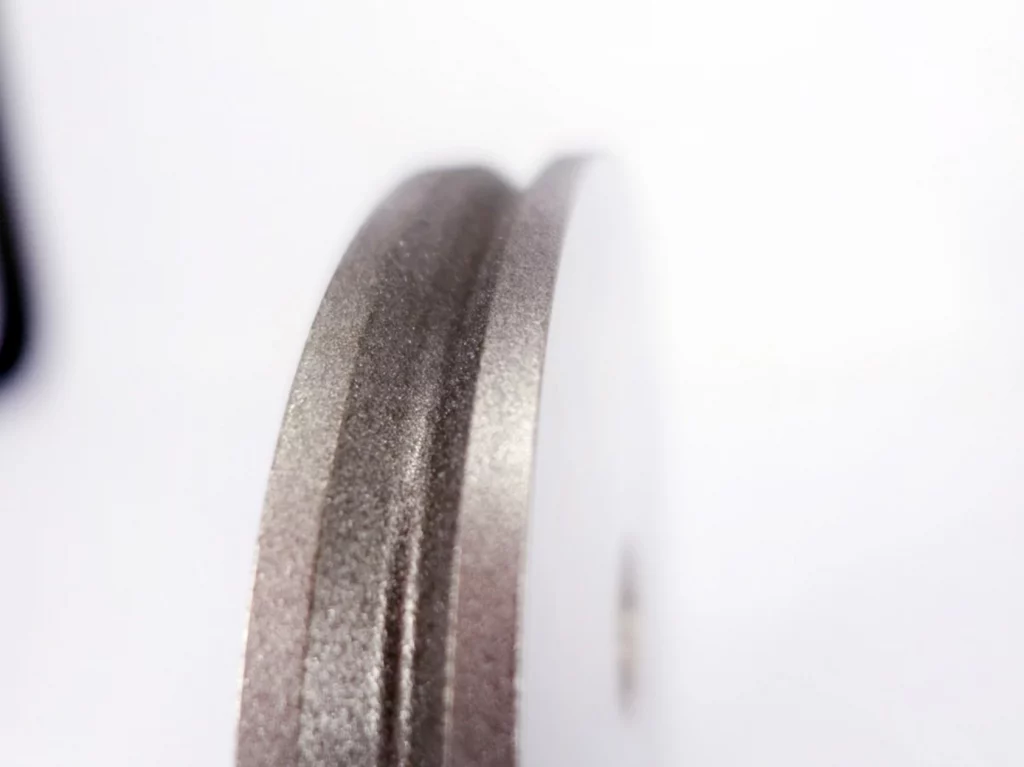
The electroforming process typically utilizes the Reverse Plating Method. High-purity natural or synthetic diamonds (CVD, PCD, or natural single-crystal) are precisely arranged on the inner wall of a mold. A nickel matrix is then electroplated to securely bind the diamonds before the outer mold is removed.
- Geometric Precision Ceiling: Extremely high. Because it replicates an ultra-precision master mold, its profile tolerance can easily reach < 2 µm, allowing for exceptionally tight radius profiles.
- Diamond Distribution Density: The outer diamond layer is densely packed and perfectly flush, delivering superior grinding wheel surface finishes (Ra, Rz).
- Durability Positioning: Ideal for complex shapes with strict tolerances under light-to-medium dressing loads.
B. Sintered Diamond Rollers
The sintering process blends diamond grits with metallic binders (such as tungsten powder, cobalt powder, and other cemented carbides), which are then subjected to High-Temperature High-Pressure (HTHP) sintering inside graphite molds.
- Structural Hardness & Rigidity: Extremely robust. The metal bond matrix provides exceptional wear and impact resistance, vastly outperforming electroformed nickel matrices.
- Durability Positioning: Delivers an incredibly long tool life. As the outer diamond layer wears down, the matrix self-sharpens under dressing friction, exposing fresh inner diamond grits. Perfect for high-volume, high-removal, heavy-duty dressing of vitrified or conventional wheels.
- Geometric Limitations: Due to material shrinkage rates during high-temperature sintering, ultra-fine and highly acute sharp profiles are difficult to sinter directly and often require post-process laser or EDM micro-tuning.
3. Field Application: Customized Geometric Specifications for High-Precision Cylindrical Grinding
In high-precision cylindrical grinding applications—such as automotive Constant Velocity Joint (CV Joint) raceways, camshafts, crankshafts, or precision bearing inner/outer ring groove grinding—the geometric accuracy of the workpiece depends entirely on the diamond roller’s profile. Therefore, customizing a diamond roller requires rigorous evaluation of the following geometric and dynamic criteria:
- Profile Accuracy: Honway’s custom engineering delivers tight unilateral tolerances within ±0.002 mm, ensuring complete shape consistency from the 1st to the 100,000th part during mass production.
- Radius Control: For the channel radii of bearing inner grooves, the precision of the roller’s apex or arc radius is critical. Custom designs allow for micro-radius compensation, preventing stress concentration or profile distortion caused by poor dressing.
- Dynamic Balancing & Run-out: During high-speed rotary dressing (typically thousands of RPM), the roller’s face run-out and radial run-out must be maintained at ≤ 0.002 mm. Any excessive run-out will transfer chatter marks onto the grinding wheel, ruining the workpiece’s surface roughness.
- Diamond Arrangement: Based on chip clearance and heat dissipation requirements, we provide customized Hand-set diamond arrangements or Random distribution. Hand-set diamonds ensure uniform load distribution across every grit, providing optimal dressing rigidity and tool life.
4. Ultimate Process Indicators: Choosing Between Climb Dressing and Counter-Dressing
When configuring the rotary dressing parameters, the relative rotational direction and speed ratio (q-value) between the roller and the grinding wheel dictate the wheel’s post-dressing sharpness and topography:
- Climb Dressing (Same Direction): The roller and the grinding wheel move in the same tangential direction at the contact point. Because the relative velocity is lower, the dressing action exerts a crushing and rubbing force. This creates a smoother, flattened (passivated) wheel surface, ideal for finish grinding processes aiming for extremely low surface roughness.
- Counter-Dressing (Opposite Direction): The roller and the grinding wheel move in opposite tangential directions at the contact point. The relative velocity is exceptionally high, allowing the diamond grits to aggressively shear the wheel’s bond matrix. This yields excellent sharpness and chip pocket depth, making it ideal for high-removal-rate, burn-free rough grinding or heavy-duty machining.
🛠️ Seeking High-Volume, High-Repeatability Form Grinding Solutions?
Honway Group features industry-leading electroforming and sintering manufacturing technologies. We engineer custom, high-rigidity solutions tailored for your automotive components and precision bearing production lines, drastically improving your process CPK and grinding wheel longevity.
👉 Explore specifications and request a custom quote: Honway Diamond Roller Grinding Wheel Dressing Series
5. Conclusion: Turning Variables into Constants with Diamond Rollers
In the competitive landscape of B2B high-volume precision form grinding, any dimensional drift caused by improper dressing or frequent downtime for tool replacement acts as an invisible monster devouring net profit margins. With their irreplaceable rigidity, perfect profile replication capabilities, and high repeatability, rotary dressers successfully transform a volatile dressing process into a highly predictable, automated constant.
6. Further Reading: Integrating the Precision Machining & Grinding Triangle
Mastering rotary dresser technology establishes an unshakeable geometric foundation for your automated grinding lines. To ensure comprehensive factory optimization across all related manufacturing cells, explore Honway’s updated technical guides to build an interconnected production knowledge network:
🛠️ Recommended Technical Guides for Integrated Processes:
- Pre-Process Milling & Cutting Alignment: Explore how high-end custom tooling enhances early-stage material removal prior to grinding in our breakthrough analysis: Advanced PCD Cutting Tools: 100-Flute Micro-Milling & Surface Roughness Optimization.
- Conventional Grinding Wheel Maintenance (Non-Form Dressing): For standard, non-volume truing adjustments, read our complete field guide: Grinding Wheel Glazing and Process Deviation? How Diamond Dressers Restore Machining Precision: A Guide to Trueing and Dressing Calibration to correct wheel passivation.
- Global Metrology Standard Alignment: Verify your final component quality by referencing our comprehensive cross-reference guide: Comparison Chart of Grinding Polishing and Surface Roughness to align international Ra and Rz metrics.