In modern high-end precision manufacturing, whether processing automotive display assemblies, high-resolution LCD panels, or executing edge-polishing routines on next-generation semiconductor substrates (such as Si, SiC, and GaN), surface integrity directly dictates final product reliability and mechanical yield strength. While conventional rigid diamond or Silicon Carbide (SiC) wheels provide excellent bulk material removal rates, their aggressive physical cutting mechanisms frequently introduce micro-scratching and destructive Subsurface Damage (SSD) on brittle-hard substrates.
To eliminate these microstructural defects and break through the sub-nanometer roughness barrier during final-stage finishing operations, Honway introduces our industrial-grade Cerium Oxide (CeO2) Elastic Grinding Wheels and specialized polishing media. This report outlines the dual mechanochemical principles behind this advanced surface-finishing technology and explains how it stabilizes automated B2B manufacturing workflows.
📋 Table of Contents
- 1. The Mechanochemical Mechanism: Why Conventional Abrasives Cannot Replace CeO2
- 2. Elastic Matrix Kinematics: Absorbing System Micro-Vibrations to Prevent Surface Scratches
- 3. Production Line Diagnostics: Resolving Glass Perimeter Micro-Chipping and Surface Haziness
- 4. Industrial Application Framework: Semiconductor Edge Polishing and Precision Optics
- 5. Technical Reference Matrix: Surface Roughness Standards and System Interoperability
- 6. Global B2B Procurement Directory & Sample Request Portal
1. The Mechanochemical Mechanism: Why Conventional Abrasives Cannot Replace CeO2
Understanding the unique performance of Cerium Oxide elastic grinding wheels requires analyzing the physical-chemical dynamics at the contact interface. Standard abrasive tools rely strictly on brittle fracture mechanics, which concentrate stress on the hard-brittle substrate and propagate micro-cracks. In contrast, when Cerium Oxide (CeO2) interacts with glass or silica-bearing substrates (primarily Silicon Dioxide, SiO2), it triggers a unique dual-action Chemical Mechanical Polishing (CMP) response:
- Micro-Scale Mechanical Shearing: The engineered CeO2 particles embedded in the wheel act as high-density, microscopic cutting edges, performing uniform, low-force physical micro-abrasion to level surface asperities.
- Solid-State Chemical Mass Transfer: Activated by localized processing pressures and frictional heat, the Cerium Oxide exhibits a strong chemical affinity for the silicon dioxide molecules, forming temporary Ce–O–Si chemical bonds. As the wheel rotates, the shear force pulls these surface molecules directly away from the substrate at the atomic level.
This molecular-level mass transfer ensures smooth surface topography without relying entirely on mechanical force. This unique mechanism gives Cerium Oxide an advantage over rigid abrasives in applications requiring zero-haze, scratch-free finishes. To support diverse component geometries and tool configurations, Honway also supplies highly customizable Cerium Oxide Polishing Leather (available in tailored slices or with an integrated handle/shank) to integrate with existing mirror-brightening machinery.
2. Elastic Matrix Kinematics: Absorbing System Micro-Vibrations to Prevent Surface Scratches
Beyond the chemical benefits of the oxide molecule, the primary performance driver of this system lies in its elastic matrix bonding structure. High-rigidity metal- or resin-bonded wheels transmit system micro-vibrations and slight geometric misalignments directly to the workpiece, leading to periodic surface defects known as chatter marks.
Honway’s specialized elastic formulation serves as a high-performance vibration damper during automated high-volume production:
- Dynamic Micro-Vibration Attenuation: The compliant elastomer matrix acts as a shock absorber, dampening high-frequency harmonic vibrations from the spindle and ensuring uniform stress distribution across the polishing interface.
- Conformal Contact Area Expansion: When executing glass edge grinding or wafer bevel finishing, the elastic matrix deforms slightly to match the workpiece’s specific R-profile or C-chamfer geometry. This conformal tracking ensures highly consistent surface roughness (Ra) across the entire edge radius.
- Controlled Abrasive Self-Sharpening: The elastic substrate is engineered to wear at a precise, predictable rate. Spent, dulled CeO2 particles detach naturally under load, continuously exposing fresh, highly reactive abrasive grains beneath. This mechanism prevents glazing and loading, eliminating a primary cause of thermal burns and severe micro-scratches.
📸 Figure 1 Reference: Micro-kinematic representation of Honway’s CeO2 elastic matrix achieving conformal contact and real-time vibration damping on fragile wafer edges.
3. Production Line Diagnostics: Resolving Glass Perimeter Micro-Chipping and Surface Haziness
Field Engineering Challenge: In high-volume LCD panel assembly and premium automotive glass processing lines, engineers frequently encounter edge micro-chipping and post-polish surface haziness. Micro-chipping concentrates stress fields along the glass edge, leading to catastrophic structural failure during downstream thermal processing or final assembly. Surface haziness reduces light transmittance and degrades sensor accuracy in precision optical setups.
💡 The Honway Engineering Commitment: These defects are typically caused by aggressive grit sizes in upstream grinding stages or unmitigated system vibrations. The Honway technical support team helps customers address these issues by introducing an optimized elastic polishing workflow. The open-pore design of our Cerium Oxide Elastic Grinding Wheels effectively dissipates grinding heat while chemically flattening the micro-fracture layers left by preceding diamond stages. This process helps reduce edge-chipping reject rates to below 0.5% and eliminates scattered light reflections. For specialized fixtures or small-batch components, our customizable Cerium Oxide Polishing Leather can turn a hazy surface into an optically clear, mirror-like finish.
4. Industrial Application Framework: Semiconductor Edge Polishing and Precision Optics
With ongoing industry upgrades, this mechanochemical finishing process has expanded from traditional glass manufacturing into high-value sectors like semiconductor wafer fabrication and advanced optical mold production. Honway provides customized formulations to meet the stringent standards of these high-margin industries:
| Target Industry Sector | Process Bottlenecks & Quality Metrics | Honway Cerium Oxide Technical Synergy |
|---|---|---|
| LCD Panels & Cover Glass | Requires rapid brightening of large-scale glass edges at high linear speeds, eliminating side frosting without introducing microscopic notches that lead to flexural fractures. | High-toughness elastic matrix formulations deliver long service life under continuous automated configurations. Fully compatible with Honway’s customizable Cerium Oxide Polishing Leather (Slice/Handle Forms). |
| Optical Lenses & Precision Molds | Aspherical glass elements for automotive wide-angle cameras and high-end imaging lenses require scratch-free surfaces with highly demanding roughness limits. | Utilizes high-purity (99%+), electronic-grade, highly active CeO2 abrasives combined with an ultra-fine grain distribution to provide a clear, haze-free surface finish. |
| Semiconductor Wafer Edge Polishing | Requires polishing the notch areas and outer circumferences of Silicon, SiC, and GaN wafers to eliminate subsurface stress and prevent defects in downstream epitaxial growth. | Employs highly porous, controlled-density foamed matrices to manage edge geometric tolerances and processing heat, consistently achieving surface roughness values down to Ra < 0.02 μm. |
5. Technical Reference Matrix: Surface Roughness Standards and System Interoperability
To optimize processing parameters—such as spindle RPM, feed rates, fluid delivery, and down-force pressures—production managers and process engineers require reliable reference data for quality control checks. We recommend reviewing Honway’s core technical insight documentation to align your finishing sequences:
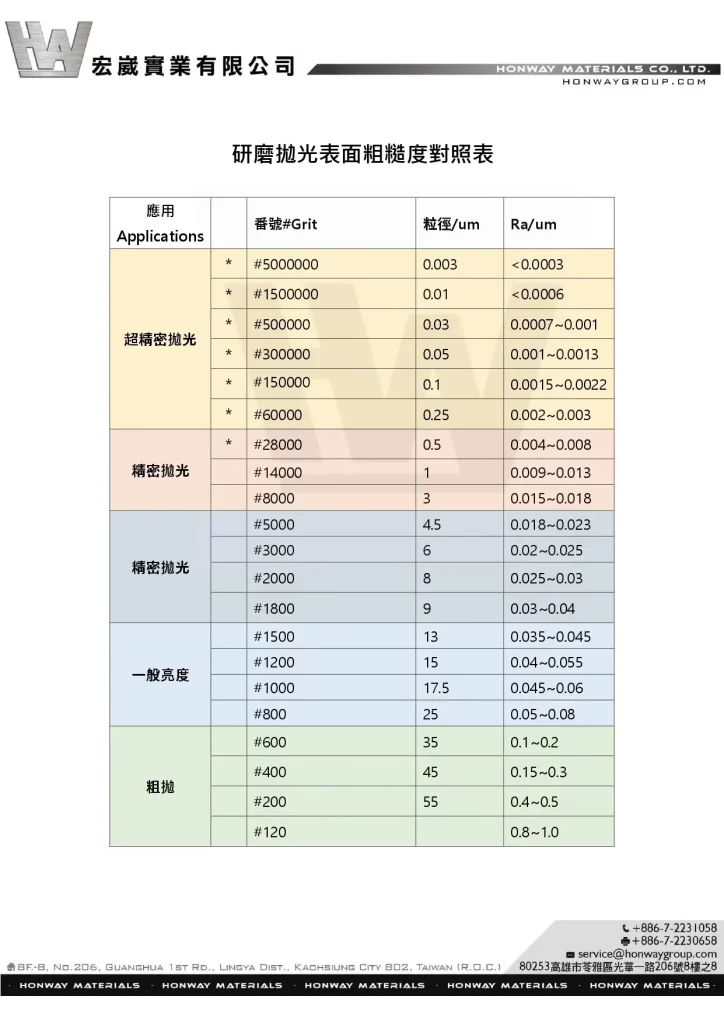
- 📊 Surface Metrology Alignment: Comparison Chart of Grinding Polishing and Surface Roughness: Mastering Industrial Mesh Size and Ra/Ry/Rz Data Conversions
- ⚙️ Advanced Automation Process Integration: Production Line Automation Deburring and Ultra-Precision Manufacturing Processes: Integrated Applications of Industrial-Grade Polishing Equipment and Ultra-Fine Polishing Technologies
- 🔬 Non-Deformative Sample Extraction: Ensuring Integrity in Metallographic Evaluation: Non-Heat-Affected Sectioning and Premium Metallographic Cutting Discs (Explore specialized structural sectioning consumables to prevent deformation prior to Meta Polishing).
- 🎯 Hard-Brittle Substrate Core Drilling: Efficient Micro-Hole Machining in Hard-Brittle Materials: Low-Chipping High-Hardness Composite Core Drilling Solutions (Access Honway’s Diamond Drill Pipe classification index to explore optimized hole-making parameters for quartz and optical glass).
6. Global B2B Procurement Directory & Sample Request Portal
Honway’s advanced surface finishing tools and specialized chemical consumables are fully qualified through rigorous tier-one industrial line audits, providing a dependable solution for maximizing material removal rates while eliminating surface defects.
🚀 Achieve True Mirror-Bright Surface Quality: Request Your Honway CeO2 Consumable Samples Today!
Honway offers customized formulation adjustments for automated glass processing operations, camera module foundries, and wafer fabrication facilities worldwide:
- 🤝 Technical Consultation & Setup Audits: For specialized material requirements or non-standard tool setups, contact our engineering desk via the 【Contact Honway Technical Experts Portal】 to schedule a 1-on-1 process evaluation.
- 🧪 Material Prototyping & Sampling Support: Provide your target substrate characteristics (e.g., Borosilicate, Quartz, SiC), current equipment speeds, and required roughness specs. Honway engineers will formulate a tailored elastic bonding chemistry and supply sample blocks for on-site validation.
Verified Honway Product Portfolios for Global RFQs & Procurement
Access official product specification pages, download engineering documentation, or submit an RFQ directly to our customer success desk:
- Customizable Cerium Oxide Finishing Media: Cerium Oxide Polishing Leather (Can be customized into slice or with handle) Dedicated Product Page →
- Flagship Ultra-Precision Planarization Platform: Super Polished Meta Polishing AS-4100 / AS-5190 Dedicated Specification Page →
Honway Customer Success & Applications Office (Global Headquarters)
· 📨 Corporate B2B RFQs: Submit your production line requirements via
【Contact the Honway Technical Projects Team】
. Please detail your specific workpiece geometry and tool interface parameters. Our engineering desk will respond within 24 business hours.
· 📞 International Hotline: +886 7 223 1058 (Monday – Friday, 09:00 – 18:00, GMT+8)
· 📱 Official Engineering Updates: Follow the official
Honway Group Corporate Feed
for information on new product releases and process technologies.