Are your precision surface finishing operations struggling with unstable yield rates, micro-scratches, or sub-surface micro-cracking induced by excessive residual stress? In the territory of ultra-precision processing, nanometer-scale tolerances dictate the boundary between high-margin throughput and catastrophic scrappage costs. If you are struggling with low Material Removal Rates (MRR) on superhard carbides, micro-fracturing on brittle optics, or low efficiency during final burnishing, your line does not require increased downward pressure—it requires a more scientifically engineered interface medium.
Honway’s FC Series Non-Woven Polyurethane Polishing Pads (Polishing Leather) are engineered precisely to shatter these manufacturing bottlenecks. Grounded in the foundational chemical bonding theory formulated by high-end optics authority Cook, L. M., final-stage super-finishing transitions beyond crude physical friction into a highly synchronized chemical and mechanical synergy. By precisely manipulating polymerization parameters, Honway has formulated a porous polyurethane structure optimized for peak performance.
- Robust Thermodynamic Stability: Honway polishing pads possess exceptional Shore Hardness stability. This guarantees that under prolonged high-velocity processing cycles, the pad maintains structural planarity against friction-induced heat, dead-locking workpiece geometric profiles.
- High Micro-Porous Retention: The signature continuous microscopic cell matrix uniformly traps and charges free abrasive grains (such as polycrystalline diamond pastes, cerium oxide, or spherical alumina slurries), establishing a highly consistent dynamic grinding layer across the interface.
Table of Contents
- 1. Plant Implementation of the Preston Equation: Stabilizing Constant MRR
- 2. Industrial Application Case Studies: High-Tier Finishing Solutions
- 3. Hardness Segmentation & Abrasive Coupling: Substrate Alignment
- 4. Honway Industrial Consulting: One-Stop Quality Assurance Backing
1. Plant Implementation of the Preston Equation: Stabilizing Constant MRR
Within advanced lapping and polishing dynamics, the Material Removal Rate (MRR) strictly complies with the classic Preston Equation:
MRR = k × P × V
Where P represents mechanical downforce pressure, V represents relative linear velocity, and k represents the critical processing constant (encompassing abrasive morphology, slurry pH, fluid kinematics, and the pad’s active shear modulus).
A prevalent failure profile in modern plants is “glazing” or rapid decay—where material removal rates perform optimally for the initial 30 minutes, followed by a total stagnation in cutting efficiency. This occurs because generic pads undergo micro-porous collapse under high-pressure, high-velocity loads, causing the process constant k to drift unpredictably across the shift time dimension.
Honway’s FC Series Polyurethane Polishing Pads deliver exceptional elastic recovery rates and shear modulus. Whether running mild surface ironing cycles or high-throughput stock removal operations, the micro-pores resist flattening and closure. This holds the process constant k static, placing your volumetric removal rates entirely under engineering command.
2. Industrial Application Case Studies: High-Tier Finishing Solutions
Honway’s polyurethane formulation maps seamlessly into advanced semiconductor and optical processing applications, establishing itself as a frontline factory solution:
A. Semiconductor Wafer Planarization (CMP)
Integrating Honway’s dedicated non-woven PU pads into final Chemical Mechanical Planarization (CMP) lines for crystalline substrates optimizes debris flushing. The micro-porous structure discharges sheared particles instantly, suppressing sub-surface micro-scratches and driving global line throughput up by 15% to 20%. For professional lab sample preparation, engineering lines utilize our dedicated Metallographic Polishing Pads to guarantee planar integrity.
B. Advanced Optical Lenses & Quartz Glass
High-precision optical lenses are heavily prone to surface haze and micro-waviness during final burnishing steps. Pairing Honway’s FC-03 polishing pad with high-purity Cerium Oxide Polishing Slurry accelerates the chemical-mechanical coupling mechanism. This dissolves localized micro-asperities cleanly, eradicating surface haze failures and maximizing transmission yields.
C. Precision Machinery & Aerospace Titanium Alloys
When interfacing with extreme-toughness or superhard substrates like Titanium Alloys and Tungsten Carbide, conventional polishing leathers suffer from hydroplaning slippage and extreme abrasive wear. Configuring Honway’s structural FC-04 pad alongside our High-Cut Polycrystalline Diamond Compound Pastes leverages extreme shear resistance to compress processing cycle times significantly.
3. Hardness Segmentation & Abrasive Coupling: Substrate Alignment
Aligning polyurethane durometer metrics to substrate hardness profiles is critical to preventing edge roll-off and structural defects.
A. Ductile Materials & Non-Ferrous Alloys (The Burnishing Approach)
- Substrate Matrix: Acrylic (PMMA), Resin Optics, High-Conductivity Copper Traces, Aerospace Aluminum Alloys.
- Recommended Configuration: Honway FC-03 Medium-Soft Polyurethane Pad + Aluminum Oxide Polishing Slurry.
- Process Mechanics: These substrates are highly ductile and highly susceptible to deformation. The compliant matrix of the FC-03 pad cushions processing downforces, enabling sub-micron alumina particles to brush over the surface smoothly. This eliminates localized edge deformation (rounding) while unlocking a mirror finish.
B. Hard-Brittle Materials & Advanced Optics (The Chemical Synergy)
- Substrate Matrix: Sapphire Substrates, Monocrystalline Silicon Wafers, Fused Silica / Quartz Glass.
- Recommended Configuration: Honway High-Hardness Polyurethane Pad + High Self-Sharpening Polycrystalline Diamond Powder or Cerium Oxide Slurries.
- Process Mechanics: According to Cook’s structural framework, active particles like ceria engage in molecular-level chemical bonding with the silicon dioxide (SiO2) molecules on glass interfaces under pressure. This temporary chemical linkage shears away surface peaks seamlessly. Coupled with a rigid Honway pad that provides high global planarization force, this setup delivers atomic-level flatness without inducing structural micro-cleavage or physical fractures.
4. Honway Industrial Consulting: One-Stop Quality Assurance Backing
Honway engineers intuitive configuration matrices to streamline your shop-floor material selections across roughing, semi-finishing, and final nanometer mirror finishing stages:
| Workpiece Classification | Typical Applications | Recommended Consumables Array | Core Processing Mechanism |
|---|---|---|---|
| Superhard Materials & Wafer Substrates | Silicon Carbide (SiC), Sapphire Optics | High-Hardness Polyurethane Pad + Diamond Grinding Solutions | Maintains static Preston parameters to suppress sub-surface micro-cracks. |
| Precision Injection Mold Steel | Mirror Plastic Molds, Hardened Tool Steel Dies | Honway FC-03 Pad + Diamond Compound Pastes | Mitigates localized shear friction to eradicate structural relief defects. |
| High-End Optical Components | Quartz Glass, Fused Silica Optics, High-Index Lenses | Honway FC Series Non-Woven Pads + Cerium Oxide Polishing Slurry | Leverages chemical bonding physics to eliminate final-stage lens haze. |
| Non-Ferrous Soft Metals | Aerospace Aluminum Shells, High-Conductivity Copper Parts | Metallographic Alumina Powder / Aluminum Oxide Slurry + Soft Pads | Deploys low downforce and slow velocity paths to neutralize edge rounding. |
*Note: Attaining a stable Ra threshold requires structural equipment stability alongside optimized pad configurations. For shop floors running tight-tolerance manual bench repairs or automated setups, pairing pads with low-vibration, high-precision driving spindles is mandatory to lock in flatness.
Honway Materials operates beyond standard catalog supply channels—we serve as your dedicated surface finishing engineering consultants. Our application teams analyze site-specific parameters, optimize slurry pH buffering scales, and deliver custom polyurethane formulation tunings tailored to your exact plant throughput goals.
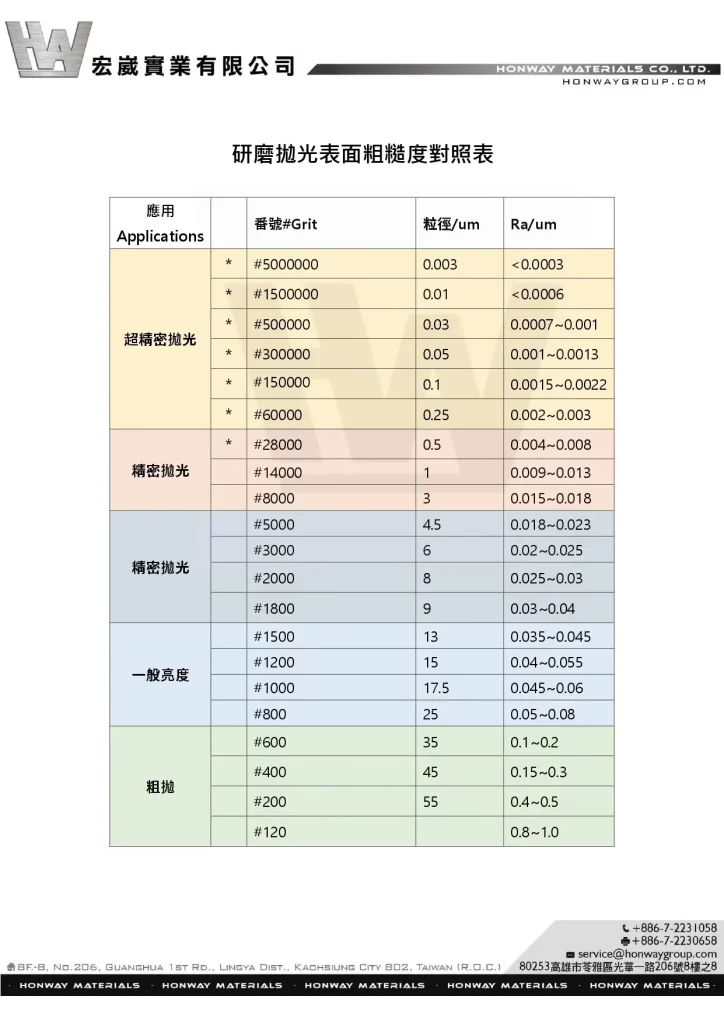
- Request Free Pad Sample Kits: Submit your substrate hardness specifications and targeted Ra metrics, and our facility will dispatch task-matched FC series pad samples directly to your plant.
- Schedule On-Site Engineering Audit: Coordinate with a Honway application expert to calibrate your Preston variables and machinery parameters directly on your manufacturing floor.
💡 Advanced Technical Resources Grid (Flagship B2B Technical Articles): To optimize the yield margins of your surface finishing cells, check out our core engineering guides:
Verified Honway Product Portfolios for Global Inquiries & Sample Orders
Browse our verified online catalog below to order sample quantities directly with premium worldwide shipping logistics, or connect with our customer success desk for contract bulk pricing arrangements.
- Peripheral Consumables: Grinding and Polishing Peripheral Consumables (PU Pads / Leather)
- Metallography Polishing Pads: Metallographic Polishing Pads (Specimen Finishing Series)
- Cerium Oxide Liquid: Cerium Oxide Polishing Slurry (Glass & Optics Series)
- Advanced CMP Liquids: Diamond Grinding Solutions / Slurries (Grinding Solution Catalog)
- Oxide Polishing Slurry: Aluminum Oxide Polishing Slurry (Spherical Series)
- Metallographic Powders: Metallographic Alumina Polishing Powder
- Precision Compounds & Pastes: Diamond Grinding Compounds / Pastes (Oil & Water Soluble)
- Polycrystalline Abrasives: Nano Diamond Powder (Polycrystalline Series)
- Monocrystalline Abrasives: Monocrystalline Diamond Powder (Category Showcase)
- Metallography Consumables: Consumables for Metallography (Specimen Prep Catalog)
- Precision Grinding Tools: Diamond/CBN Grinding Wheels & Precision Grinding Rods
Honway Customer Success Office (Taiwan HQ)
Official B2B Inquiry Email: [email protected]
Business Hours: Monday – Friday, 09:00 – 18:00 (GMT+8)
International Direct Line: +886 7 223 1058 | Official Social Media: Honway Group Facebook