In the world of materials science and industrial applications, antimony (Sb), though not as widely known as silicon, gallium, or germanium, is an indispensable element in modern electronic components, alloy materials, and flame-retardant technologies. Thanks to its unique physical and chemical properties, antimony has played a crucial role from ancient mineral applications to today’s high-tech industries.
Table of Contents
Historical origins
The use of antimony can be traced back to ancient Egypt around 3100 BC, where people ground antimony trisulfide (Sb₂S₃, stibnite) into powder to use as a cosmetic for black eyeshadow. In the Middle Ages, the alchemist Jaber is believed to have isolated metallic antimony. In the 17th century, the German chemist Andreas Libavius further studied methods for producing antimony. In 1783, the Swedish scientist Anton von Swab first discovered pure antimony in nature, laying the foundation for subsequent scientific research.
Introduction to Antimony
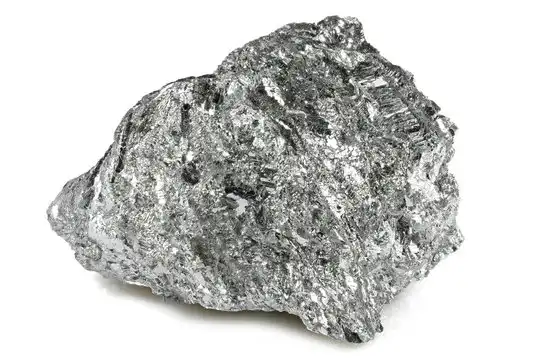
Antimony (symbol Sb, derived from the Latin word Stibium), atomic number 51, atomic weight 121.760. It is a silvery-white metallic element with a metallic luster, commonly found in the naturally occurring sulfide mineral stibnite. Antimony belongs to Group 15 (Nitrogen Group) of the periodic table, with an electronegativity of 2.05, between that of tin and tellurium.
Antimony is stable at room temperature and does not readily react with oxygen in the air, but at high temperatures it can form antimony trioxide (Sb₂O₃), which exhibits good corrosion resistance.
Physical and chemical properties
- Appearance: Silver-white with a metallic luster
- Mohs hardness: 3 (brittle, not suitable for making tools directly)
- Density: 6.697 g/cm³ (25℃)
- Melting point: 630.63 ℃
- Boiling point: 1587 ℃
- Electrical conductivity: Poor conductor of electricity and heat
- Allotropes: At room temperature, they mainly exist in the stable metallic form of antimony.
The physical form can be powder, granules, ingots or rods, depending on the industry demand.
Chemically, antimony can be trivalent or pentavalent and can form a variety of compounds with elements such as oxygen, sulfur, and chlorine. Antimony trioxide is widely used in flame retardant materials.
Purity and Product Specifications
| Specification | Purity | Detection of impurities | Total impurity content |
| High-purity antimony (5N) | 99.999% | Ag、As、Bi、Au、Cd、Cu、Mg、Mn、Ni、Pb、S、Zn、Si、Fe | <10ppm |
| Ultrapure antimony (6N) | 99.9999% | Ag、As、Bi、Au、Cd、Cu、Mg、Mn、Ni、Pb、S、Zn、Si、Fe | <1ppm |
| Ultra-high purity antimony (7N) | 99.99999% | Ag、Au、Cu、Mg、Ni、Pb、Zn、Fe | <0.1ppm |
Scope of Application
| Features and uses | |
| High-purity metallic antimony | Ideal material for the production of semiconductors, electric heating devices, and far-infrared devices |
| Antimony-lead alloy | The preferred material for corrosion-resistant chemical pipelines and cable sheathing. |
| Antimony-tin, lead-copper alloy | High strength and extremely wear-resistant, used in the manufacture of bearings and gears. |
| antimony white | Colorants, flame retardants, glass decolorizing and clarifying agents, organic synthesis catalysts, precipitants for titanium dioxide production, and gasoline additives. |
| Antimony white + antimony sulfide | rubber filler |
| Antimony trisulfide | Producing safe matches, ammunition, and firecrackers |
| Antimony pentasulfide | Used in the manufacture of rubber and veterinary drugs |
| Antimony triamine | Used in medicine |
| Antimony gluconate | Used for leishmaniasis |
| Sodium pyroantimonate | High-grade glass clarifying agent and decolorizing agent |
| Antimony acetate | Catalysts for the chemical fiber industry |
1. Semiconductor and Electronics Industry
- Preparation of group III-V compound semiconductors, such as indium antimony and gallium antimony.
- Dopant: Doping elements for n-type silicon and germanium wafers, used in diodes, infrared detectors, and Hall effect devices.
- Electronic cooling components: Antimony compounds have a thermoelectric effect and are used in thermoelectric coolers.
2. Alloy materials
- As an alloying element for lead, tin, aluminum, and copper, it can significantly improve hardness, wear resistance, and corrosion resistance.
- Lead-based antimony alloys are widely used in battery plates, chemical pumps and pipes, and cable sheaths.
- Reinforced alloys are used to manufacture wear-resistant parts such as bearings and gears.
3. Flame retardancy and other applications
- Antimony trioxide is often added to plastics, textiles, and rubber as a highly effective flame retardant.
- Used in paints, ceramics, fireworks and enamel products.
- In the military field, antimony is used in night vision goggles, navigation systems, and special munitions.
Conclusion
Antimony is a crucial material that has transcended time, found in everything from cosmetics to high-tech applications. With the development of semiconductor, energy, and new materials technologies, the importance of high-purity antimony will continue to rise. Whether for alloy strengthening, flame retardant protection, or next-generation semiconductors and optoelectronic components, antimony demonstrates its irreplaceable value.
More Honway raw material information
To learn more about how raw metals are driving next-generation technology, click on the links below to explore their properties, applications, and market prospects:
- Raw material – Arsenic (AS)
- Raw material – Selenium (Se)
- Raw material – tellurium (Te)
- Raw material-Indium (In)
- Raw material-Germanium (Ge)
- Raw materials – Cadmium (Cd)
- Raw material-Gallium (Ga)
Read more about related topics:
- Gallium (Ga)>>>Gallium (Ga) – From Rare Metal to a Key Raw Material for Semiconductors and New Energy
- Cadmium (Cd) >>>Cadmium (Cd) – From Byproduct Metal to a Key Raw Material for Industry and Technology
- Germanium (Ge) >>> Germanium (Ge) – From Mendelssohn’s Prediction to the Core Material of Modern Semiconductors
You can also directly “contact our Honway expert team,” and we will provide the most professional customized consultation and solutions.
We offer customized adjustments to the grinding process, tailored to meet processing requirements for maximum efficiency.
After reading the content, if you still don’t know how to select the most suitable option,
Feel free to contact us and we will have specialist available to answer your questions.
If you need customized quotations, you’re also welcome to contact us.
Customer Service Hours: Monday to Friday 09:00~18:00 (GMT+8)
Phone: +8867 223 1058
If you have a subject that you want to know or a phone call that is not clear, you are welcome to send a private message to Facebook~~
Honway Facebook: https://www.facebook.com/honwaygroup
You may be interested in…
[wpb-random-posts]